What we did posts only click here

Friday, 12 February 2016

Marble Footprint. Guest blog by a child volunteer

Marble Footprint

I like this object because it is interesting seeing a person’s footprint from ancient Egypt (and it reminds me of bigfoot).  The footprint was used to make sure that the owner stayed in the presence of the gods.  People gave personal gifts to the gods through a worshipper at the temple, wanting to secure benefits.  Different types of votive offerings were used.  They were objects which represented the real things.  For example, people give stelae, figures of cows and cats, models of ears and eyes, fertility figurines and jewellery.

by

Hywel Protheroe Jones


Hywel has been a volunteer with the Egypt Centre since 2007, initially as one of our young volunteers (who are aged 10-18) and more recently as an adult volunteer. He wrote this when he was a child volunteer.

For more information on this object click here.    

Wednesday, 10 February 2016

Gruesome rites? Book of the Dead Fragment.


I thought in this blog I would concentrate on what is going on in the illustrations to this piece of the Book of the Dead. And, if anyone has any comments please feel free to let us know. Part of the reason for my doing this blog is so I can learn (as well as letting you know about our collection).

First some background. This particular piece is Late Dynastic-Ptolemaic. It was sold to Henry Wellcome in Sotheby's sale of 1932 and is now catalogued in the Egypt Centre as W867. It is a papyrus sheet from the Book of the Dead. This particular piece depicts the hymn to the rising sun, Chapter 15 of the Book of the Dead. The scroll belonged to Ankh-Hapi, son of Pa-Khered-en-Min and Ta-di-Aset. Other pieces of the book are in the British Museum (EA9946) and two other pieces are known from elsewhere (Hurst 1997, 14-16). It has been published by Kate Bosse-Griffiths in ZAS 123 (1996) p97-102.

And now to the illustration along the top.


It shows a funeral ceremony in front of the tomb, a vignette which usually illustrates Chapter 1 in the New Kingdom but which by the Late Dynastic and Ptolemaic Period can be used to illustrate chapters 1-15. Anubis (or a priest wearing an Anubis mask) appears on this scene, together with the sacrifice of a bull, the implements used in the Opening of the Mouth Ceremony, and an adze being used in the ceremony, etc. Anubis/priest with Anubis mask is shown propping up the coffin of the deceased in front of a lamenting woman and a priest who is purifying.


The mummy would be propped up in front of a stela in the courtyard of the tomb and exposed to the rays of the sun. It has been suggested that the setting up of the mummy ‘before Re’ took place at midday (Assmann 2005, 318; Taylor 2010, 88), though as this illustrates a hymn to the rising sun, perhaps the ceremony took place in the morning. The courtyard of the tomb would have been symbolically in the east. The practice of setting up the mummy in the courtyard to receive the rays of the sun, in front of stelae, probably with solar hymns thereon, gained popularity from the New Kingdom (Assmann 2005, 320). Re can be seen enthroned on the far left. The presentation of the mummy before Re mirrored the mythical judgement before the enthroned god which is shown, for example, on the coffin of Iwesemhesetmut in the Egypt Centre (in fact on this coffin it is shown twice, as a judgement by Osiris, and a judgement by Re). The pointed roof of the tomb which is shown in front of Re and his offering table actually went out of favour during the Ramesside Period, though would have been understood in later times as a tomb.

The figure holding up the mummy may be either mythically understood as Anubis, or as an actual priest in an Anubis mask. Anubis masks have been found, making the latter interpretation seem more likely. One is now held in Harrogate Museum (HARGM10686 02). Another is in the Roemer Pelizaeus- Museum, Hildesheim (1585). Additionally, at Dendera is a depiction of a procession of priests. One is shown wearing a mask (that it is a mask seems to be the case from the way it is shown as transparent, see Mariette IV, pl. 31).

The rite of placing the mummy in the sun, purifying it and performing the Opening of the Mouth Ceremony, is described in TT23 (Assmann 2005, 323–324). The Opening of the Mouth Ceremony ensured that the deceased was able to act after death.


To the right of the priest forming the opening of the mouth ritual is a priest wearing a headdress of two ostrich feathers. He is the lector priest. From the Third Intermediate Period the lector priest was sometimes shown with such a headdress and was thus sometimes called a ‘wing-wearer’ (Greek-pterophorus). Lector priests were responsible for chanting or reading from sacred texts and sometimes acted as oracles for the people.

To the far right is a dreadful scene, an essential part of the Opening of the Mouth ritual. A foreleg of a still living calf is chopped off, witnessed by its mourning mother. The leg is presented to the deceased while still warm (Assmann 2005, 324-329). Both the leg and the mourning cow were important in ensuring that the deceased was reborn. In some texts, it is suggested that the calf represents the god Seth who must be punished so that eternal life is possible.


References

Assmann, J. 2005. Death and Salvation in Ancient Egypt. Translated from the German by David Lorton. Ithica and London: Cornell University Press.

Hurst, N. A Passion for the past. Historic Collections from Egypt and the Levant. Cambridge (Mass,).

Mariette, A. 1871. Dendérah: description générale du grand temple de cette ville (Vol. 4): Plates, Paris.

Müller-Roth, M. and Weber, F. 2012. Pretty Good Privacy. In Lucarelli, R., Müller-Roth, M. and Wüthrich, A. Herausgehen am Tage. Gesammelte Schriften zum altägyptischen Totenbuch, Wiesbaden: Harrassowitx,  113-134.

Taylor, J.H. 2010 (ed.) Journey through the afterlife. Ancient Egyptian Book of the Dead. British Museum Press.

Thursday, 21 January 2016

Thank you Griffith Institute -it's amazing what you can find out online!

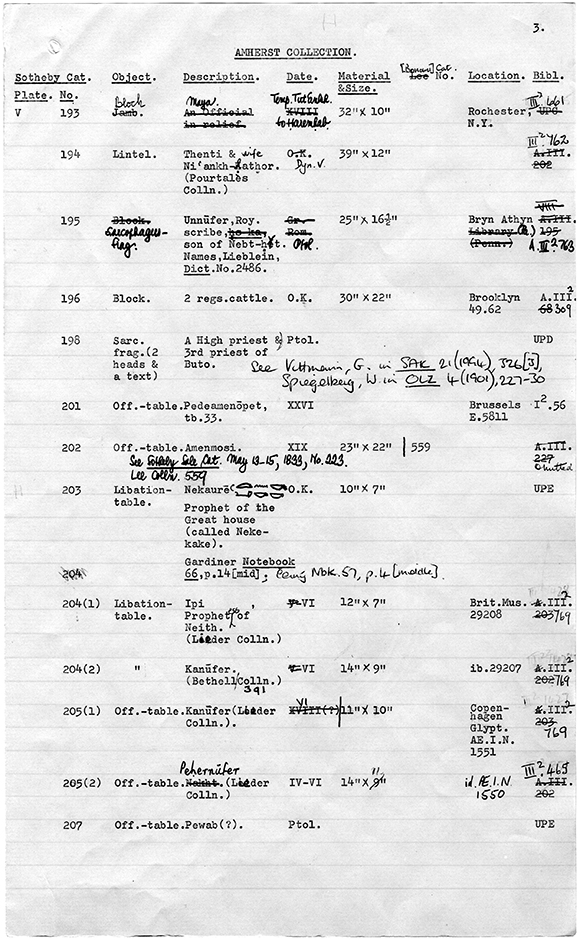
Last term we had a few MA students in the Egypt Centre looking at 'real' hieroglyphs (instead of ones in books). One of the things we looked at was the Tjenti stela, a 5th Dynasty lintel from Saqqara in our upstairs gallery. As we were going to look at this I tried to find out a bit more. I'm no expert on Saqqara, the 5th Dynasty, or hieroglyphs but was really lucky. An online document from the Griffith Institute which gives some useful background information, and also from the Porter and Moss (Topographical Bibliography) volumes now online.

But first here is a pic of the lintel:


And here is a line drawing of it:


This is what we made the translation out as: An offering which the king gives and which Anubis Lord of the sacred Land gives, so that he may be buried in the beautiful and great land of the west. Voice offerings of bread and beer, oxen and fowl on the festival of every day for the Overseer of the Craftsmen, Tjenti. His wife's name is given behind the couple as Ni'ankh-hathor

But I am puzzled by the sign underneath the bread, bottom right. Is it a variation on the sign for cloth. Clearly I need to do more research here.

Back to its history. Some time ago, an outside researcher drew my attention to the Amherst collection, which is online at the Griffith Institute. The key information regarding the stela's history as belonging to the Amherst and Portalès-Gorgier collection can be found online at: http://www.griffith.ox.ac.uk/gri/gif-files/Amherst_03.jpg The document also states it was sold as lot 194. 

But what did I find out purely by googling:

The Topographical Bibliography (III.2.762) mentions that a lintel of Thenti and his wife Ni'ankh-hathor appears in the Wilkinson MSS xiii.71 and Gardiner Notebook 66 p. 18. The Gardiner Notebook is that list of Amherst artefacts compiled by Crum (Galán, J.M 2000, Brief Communications, JEA 86 p.148, footnote 25). I don't know about the Wilkinson MSS. This isn't online so will have to go to Oxford for that.

I  found online that Comte James Alexandre de Pourtalès-Gorgier was a banker and art collector (1776-1855). He created a gallery of antiquities in Paris. After his death, Lord Amherst of Hackney purchased some of his artefacts. This item was resold in the Sotheby Sales of June 13th-17th 1921.

But I'm still not sure about that sign below the bread sign- more book research as opposed to googling needed here! And of course the Wilkinson MSS.

Wednesday, 20 January 2016

A bit of a shrine with an unknown king

I am trying to find out more about this item. It is number EC485 in our collection and measures 264 by 164 mm. It has been mounted on a piece of wood sometime before it came to us. This is what I have discovered so far but would appreciate it if anyone has any helpful comments, or even parallels. Alexandra von Lieven has given us some very helpful information with regards the style (showing its Ptolemaic date), But further comments are always welcome.

It seems to be the door cover of a (shrine). It is made from wood with modelled gesso (plaster) and would originally have been gilded. The pivot/hinge is on the left hand side. The shrine would have held an image of a god. The decoration shows a king offering to the god within the shrine (who may originally have been depicted on the missing right door leaf). The style of the piece suggests a Ptolemaic date.

The king is kneeling, facing right and offering incense with his left arm. He wears a shendyt kilt and the blue (khepresh) crown. Kushite kings (25th Dynasty) preferred other crowns (Collier 1993) but is brought back by Saite (Russman 1995) rulers (from 664 BC) and used by later kings. It was often worn when the king was shown offering. In front of the king’s head is an empty cartouche. Empty cartouches are relatively common feature in Ptolemaic royal scenes. Above the figure is a pt (sky sign) with a row of stars therein and above that, a row of uraei. Stars are also featured on the Late Period naos of Amasis, Louvre E605). Below the king is a row of doors evoking early royal palace facades (also featured on the naos of Amasis, Louvre E605 and the naos of Darius, British Museum EA37496). This façade decoration is also seen on earlier shrines such as the sides of the small golden shrine of Tutankhamun.

Fragments of other small shrines are known in other museums. These are usually made of wood and inlaid with glass or precious stones (e.g. BM EA37496; Louvre E605). Alternatively, they may be wood covered in gold silver or copper (Hope 1998, 829 fig. 9; Spencer, N. 2006, 4).  Unfortunately, often they are without archaeological context. And, if anyone knows of anymore please can they let me know.

A light shrine, made of wood, seems to have been called by the ancient Egyptians a sH-nTr (Spencer 1984, 114, 139 footnote 167). These seem to have either been used as inner temple shrines or as portable outdoor shrines. Small, light shrines were sometimes reused as coffins for animals (Colburn 2014, 259).

Shrines to the gods were often kept in temples. Usually these consisted of an outer stone shrine and within that a portable wooden shrine with two-leaved doors (though also see Spencer 2006, 4). Such double doors were known as ‘the gates of heaven’. Lorton (1999, 128) suggests that the cult statues from such shrines would have been a foot or so in length. While the doors to stone shrines could also have wooden doors covered in precious metal, the larger size of such shrines suggests that ours is unlikely to be part of an outer shrine.

A naos door with inlaid with glass from the British Museum (EA37496) is around 28cm in length, so of a similar height to this example. Like ours, the king is making an offering and is standing on a surface similarly decorated to ours. However, other shrines, suggest much larger cult statues (Teeter 2011, 43).

Shrines could be erected outside temples for temporary festivals, and placed on wooden barques for processions. Such shrines would need to be lighter than the monumental outer shrines in temples. There are also very small shrine doors known from museum collections which have been interpreted as models. Examples include the gilded wood naos door British Museum EA38255 showing Nakhthorheb kneeling and holding ceremonial basket. This latter measures around 11cm in height.

The shrine itself, as an enclosed box, would have been dark. The opening of the doors of the shrine would have let in the light allowing the god to be reborn and for worship to take place (Finnestad 1985, 94–95). The two doors to shrines imitated the two doors to heaven. It seems likely that the missing leaf in our example would have shown the god (as in the naos of Amasis, Louvre E605).

The object was puchased in 1992 by Sir Henry Welcome at an auction of items owned by MacGregor.


References

Colburn, H.P. 2014. The Archaeology of Archaemenid rule in Egypt. Unpublished PhD thesis, University of Michigan

Collier, S. 1993. ‘The Khepresh Crown of Pharaoh’, Ufahamu: A Journal of African Studies, 21(1–2), 137–155.

Finnestad, R. B. 1985. Image of the World and Symbol of the Creator. On the Cosmological and Iconological values of the Temple of Edfu. Wiesbaden: Otto Harrassowitz.

Fischer, H.G. 1996. Egyptian doors inside and out, In Fischer, H.G. Varia Nova, Egyptian Studies III, The Metropolitan Museum of Art, 91–98.

Hardwick, T. 2003. The iconography of the blue crown.
Journal of Egyptian Archaeology 89, 117–141.

Lorton, D. 1999. The Theology of Cult Statues in Ancient Egypt. In Dick, M.B. (ed.) Born in Heaven, Made on Earth: The making of the cult image in the ancient Near East. Winona Lake, IN: Eisenbrauns, 123–201.

Russman, E.R.1995. Kushite Headdresses and ‘Kushite’ Style. Journal of Egyptian Archaeology 81, 227-232.

Spencer, N. 2006. A Naos of Nekhthoreb from Bubastis. Religious Iconography and Temple Building in the 30th Dynasty. London: British Museum Press. http://www.britishmuseum.org/research/publications/research_publications_series/2006/a_naos_of_nekhthorheb.aspx acessed January 2016.

Spencer, P. 1984. The Egyptian Temple. A Lexicographical Study. London, Boston and Melbourne: Kegan Paul International.

Teeter, E. 2011. Religion and Ritual in Ancient Egypt. Cambridge: Cambridge University Press.

Friday, 13 November 2015

Daemon snakes and green skinned goddesses

Been finding out a bit more about this, W1307.


I thought is showed the ouroboros, a symbol of eternity,  surrounding Isis. It appears I was wrong. A really good PhD thesis by Dana Reemes shows that the idea of the snake biting its tail as a symbol of eternity did not come in until much later. Instead, this snake, which isn't biting its tail is more likely to be a protective symbol surrounding the deceased as the solar-Osirian unity. Snakes like this appear on several coffins of the Priests of Montu at found at Deir el Bahri.

Moreover, this is actually the upper foot part of the coffin, designed so that it could be seen by the deceased. So, if we looked at it on the complete coffin it would appear upside down.

Anyway, if you are interested I have more on the fragment here.

Thursday, 22 October 2015

Amarna, looking at flints, playing with dogs!

I know loads of you will disagree but I find the whole business of the royal family at Amarna, who succeeded whom, etc., a bit dull. I'm not really interested in who Smenkhkare was, or Nefertiti. What I do find interesting is the fact that this site is really good to study New Kingdom Egypt more generally. It has a relatively short chronology, so not so much intrusion from earlier or later periods than on many other sites. Also it's a big site with several different social/technological areas so it gives some idea on how ancient Egyptian society and technological changes worked. And, of course, lots of settlement type artefacts as opposed to purely funerary ones.

What's this leading too? I am interested in lithics, so have felt very privileged to be allowed to study the lithics at Amarna. In 2009 I looked at the material from Panehsy's Great Aten Temple House (associated with cattle butchery). There is a brief report here (see page 7). Then, a couple of weeks ago I went to look at material from other areas of Amarna. Many, many thanks to the Middle Egypt inspectorate of the Ministry of Antiquities, especially Inspector Marwa Ahmed Osman, and also to the Amarna Project directed by Barry Kemp

I arrived in Cairo at the end of September. A small team of us traveled from Cairo to the Amarna dig house. For those of you who are used to digging in the UK, the dig house at Amarna is very civilised with showers and proper rooms with beds (no camping in a field). We even had fans to keep us cool. And, it also looks very pretty. Here it is. There is a police HQ right outside to keep us all safe and a couple of lookout towers.

On the 1st of October the magazines were opened under the watchful eye of the Inspector. How this was done was a bit like an ancient Egyptian ritual. The brick blocking to the magazine was knocked down with hammer and chisel, etc. Then the lead seal on the door was checked by the Inspector Marwa Ahmed Osman. Here she is checking the seal to make sure it wasn't broken. Yes, a lady Inspector (well I liked that).

The artefacts we were all working on were taken into the dig house. Chris Stimpson from Oxford was making a study of bird bones. Gretchen Dabbs from the Southern Illionois University was looking at human bones from the North Cemetery. And, William Schaffer, from the same University, was looking at teeth and how very small variations in them could be used to study ancestry. All much more exciting, in my opinion, than the identity of Smenkhkare. 

And here is my work station. The flies were more annoying than the heat! I have yet to write up a proper report so wont tell you about that in detail now. However, it can be said that as one would expect in a late Bronze Age culture, the lithics were largely expedient tools. That is, most weren't deliberately made to a particular shape. Rather, they consisted of flakes and blades which would be selected and used as and when needed. This would be a very efficient way to use the material. A freshly knapped flint flake would be much sharper than a metal knife. There were one or two, what one might call 'formal' tools, mainly sickles and round scrapers. Several different types of flint was used.


And back to life in the dig house. We were fed and the site generally looked after by the Amarna Project's Egyptian team. The cook is excellent! 4 cats help keep the rodent population down. Here is one eating a hoopoe bird (a snake was eaten the day before). Bit sad about the bird as there had previously been two hoopoes.

Outside the dig house, on the way to the toilet block, we would often encounter the dogs. Most of the dogs around Amarna are semi-feral and bark and growl. They have grown used to people throwing stones at them. However, two dogs were really, really friendly. I really wish I could have 'rescued' them and brought them home. They were mother and daughter. The daughter wanted to play and would cling onto your clothes when you went back to the dig house. Here they are. The photograph was taken in the morning. The mother is on the left.

Tuesday, 15 September 2015

Plaster casts, class and art. CIPEG 2015.


We have a handling tray of real ancient artefacts (not masterpieces) for all visitors to enjoy at the Egypt Centre because we believe in the importance of handling the real thing (see the picture)

But have still been thinking about some of the things I learnt from CIPEG 2015. Something that came out time and time again was how in the early days of museums (what one might consider early varied from museum to museum), copies of masterpieces could be held to be more important than ‘second rate’ actual objects. Interesting and completely opposite to what I had hitherto believed. I always like the idea of the real object, even if grotty because of its magical contagion value. That’s why I got interested in ‘old things’ and ended up working in museums, because ‘old things’ are somehow linked directly to the past and can somehow transport you there. And of course, I have grown up in the modern western tradition with its emphasis on ‘authenticity’ (whatever that means). So, my take on plaster casts was that they may be beautiful but they are only real in so far as there post manufacture history is concerned. If they had value it was more to do with the recent past, perhaps as evidence for changes in what was considered important in Egyptology. Additionally, to be honest, I don’t know what masterpieces are. I believe others claim they have to be aesthetically beautiful and fairly rare? So a beautiful black-topped redware pot wouldn’t count as a masterpiece. What if it was an unusual shape?

But to return to the point, it seems that generally the real artefacts, even if common and ugly have gained more importance, particularly in the 20th century. So how and why did things change? Well, I have read some interesting stuff by Alice Stevenson. It can be accessed here. She shows how the partage system and Petrie’s distribution of finds to museums meant that the ‘grotty’ items, typical of most archaeological excavations, became increasingly valued. At CIPEG 2015 we learnt from Alice Williams (an ex- Egypt Centre volunteer now doing her PhD at Oxford :-) ) about how Petrie’s exhibitions of items in London were so well attended. Maybe these exhibitions too helped show ‘the general public’ what real excavated remains were like, that they were rarely masterpieces of ‘art’, but nevertheless of value.  Additionally too, one may expect that the increase in the belief in the importance of ‘science’ and technology, also meant that everyday artefacts were more valued.

But, I am wondering if there could be a class element to all this?  Could it be that the masterpieces were more inclined to be valued by those well-educated, elite individuals with the necessary training, those brought up learning the classics and appreciating art?

One might argue that archaeology is associated with the non-elite, technology and archaeology; and classics with the elite and written text. Chris Stray has written on this. The growth in the importance of the everyday object, as opposed to the masterpiece, could also be bound up with increasing influence by the non-elite, less interested in aesthetics and more interested in technology? Perhaps it’s still so. There are different tribes in Egyptology. I wonder if the backgrounds to those interested in ‘art’ differ markedly from those interested in say, technology?

I am also thinking, should we make more use of our plaster casts? We only have a couple, but they are copies of famous things elsewhere. Should we use them in teaching? As CIPEG taught me, other museums do. Nika Lavrentyeva gave an excellent talk on the use of plaster casts in the Pushkin Museum. I’m not sure I feel so excited about copies as the real thing, but maybe that is a result of my background. 

Stray, C., 1998. Classics Transformed. Schools, Universities and Society in England, 1830-1960. Oxford: Clarendon Press.