What we did posts only click here

Tuesday, 10 June 2014

Guest Post by Beverley Rogers: Peering Beneath the Layers

Peering beneath the Layers
or
The day we took ‘Rover’ for a walk

by Beverley Rogers


As Carolyn, Wendy and myself walked into the Faraday Building on the morning of 30 April, the students and staff, noticing that Carolyn carrying a big box in her arms, kindly opened the doors to allow us to pass.  They had absolutely no idea what we were carefully guarding as we carried on through to the Engineering Department in time for our appointment with Dr. Richard Johnston.   They may have been more than a little surprised had they known- for inside the rectangular box, delicately protected in tissue, was ‘Rover’ the Egypt Centre’s mummified dog (EC438).


The three of us had come to meet with Richard to discuss the results of an exciting collaboration which has risen between The Egypt Centre and two of the colleges from Swansea University.  The Institute of Life Science and the Engineering Department, together with the Egypt Centre, are helping to bring Egyptian antiquities ‘back to life’ by allowing mummified remains to be unwrapped without evasive procedures.  As part of this project, we had brought ‘Rover’ along to see if he was a suitable candidate. 

Richard, Senior Lecturer in Material Science in the College of Engineering, greeted us in his laboratory, which houses an impressive x-ray machine and a 3D scanner.  Digital imaging is key to this collaboration, for several of the mummified objects held in the Egypt Centre’s collection have undergone 2D, 3D scans and CAT scans over the last few months to determine what is inside their mummified wrappings.  The results have been truly astonishing. 

It should be said that it is not the first time that Richard has worked on projects with a historical theme. Richard has worked with the Mary Rose Trust, where human remains from the Mary Rose have been x-rayed.  He has also previously assisted Egyptology at Swansea by working with Dr. Kasia Szpakowska in her research on clay cobra figurines and their ritual breakages, by analyzing the experimental fractures of modern made objects.  The idea to apply digital technology to objects from the Egypt Centre came to him last year.  “It is very rare to have such an important resource on campus” Richard told us.  ‘We wanted to take advantage of that”.  After pitching his idea to curators Carolyn and Wendy, a selection of mummified animals were chosen for the first scans.  Both Carolyn and Wendy had warned Richard that often a ‘cat mummy’ or ‘bird mummy’ may in fact turn out to be something completely different – a bag of dislocated bones perhaps, or twigs and debris wrapped up to resemble the supposed animal.  The results when they came through however were more than could have been hoped for.

2D Imaging

Four objects have undergone 2D imaging so far –  two cat’s heads,  a bird mummy and a further body of a cat.  Results show that the scan of one of the cat heads seems to be no more than a bag of bones, however the bandages with its layers and fibers have come up so well that the individual strands of the weave can be seen.  This in itself is exciting!  The second cat head is an actual skull and clear cracks can be seen indicating damage. The bird mummy was revealed to have a perfectly intact skeleton and the imaging is so detailed that it could easily be identified as to what type of bird it is by the right kind of specialist.


Richard showing us the cat’s head before digital ‘unwrapping’


Scans of the cat’s head from different perspectives


Scans of the other cat -  originally from the Aberystwyth collection – literally blew the three of us away.  It is perfect in its detail and, the ability to rotate the image on the screen, allowed viewing to be seen from all angles and the high resolution of the scanning showed remarkable clarity.  The cat’s ears are situated above its head and are shown separated from it.  You can also see that there has been a lot of damage to the skull in the region of the right eye socket.  The cat also seems to have a full set of teeth which suggests that it was not old when it died.  These scans are so clear that further research could be undertaken to look at age of cat and type of cat by a feline specialist.  The manner of death could also be a source of further investigation.


Aberystwyth cat mummy showing dislocation of ears


Close up of the Aberystwyth cat showing Damage to skull by the right eye socket

Amazing detail of the teeth of the cat mummy
All images are to be given to the Egypt Centre for their future display within the galleries and outside foyer.  A huge thanks must be given to Jack Christie – 3rd year graduate student in the College of Engineering- for the use of his research images.


3D Imaging

3D imaging, is I must admit, completely new to me.  Richard’s lab is kitted out with both a 3D scanner and printer, and I was keen to learn how it works.  I will attempt to explain in layperson’s terms.  Once an object is scanned, a 3D model of the object is printed using plastic.  The raw material, which is fed into the printer from above, looks exactly like strimmer cord, which you see used in garden mowers.  It is relatively inexpensive and lightweight to use and produces very realistic and intricate detail.  An example shown to us that day was a model of the Eiffel tower (see below), created recently by Richard’s team.  It was made up of the most exquisitely complex struts and layers.


Wendy and Carolyn with 3D scanner in background.

Richard demonstrating the 3D scanner


Richard shows us the plastic cord used to create 3D models


3D model of the Eiffel Tower


The ways in which this type of printing can be used is becoming more and more numerous and this type of printing will certainly become more popular as time goes on.  One use that has recently hit the headlines at the time of writing this article is in the production of casts for limb breakages.  The design allows ultrasonic treatment to be transmitted through the cast and  can be hooked up to an ultrasound machine that promises to reduce the time it takes for a broken bone to mend. The cast is lighter, better for the environment and more comfortable than bulky plaster ones.


3D Plastercast


In terms of how this technique can be used in Egyptology research, well Richard was able to show us a first hand example.  Some months ago, the Egypt Centre had agreed to lend artifact number EC308 – labeled in the archive records as a mummified snake – to the College of Engineering to see if there was an animal within the bundle of linen.  When scanned, and a 3D model of the contents produced, it did indeed reveal that there was a complete snake within the bandages.  The 3D model took 10 hours to print due to the complexity of its shape; the mass of ribs on the snake meant that the scanner had to print a scaffolding structure to support the printed object so it can build up the shape (the scanner cannot print in mid-air but instead has to be supported by a structure.  An example of the supports can be seen below).   It can be a real nightmare to remove the supports, hence the 10 hours taken to complete the model.  On the plus side however, what was then left was an accurate representation of the ancient snake without there being any harm done to the linen in any way.  Richard also showed us high resolution images of the snake on screen.  This allowed us to travel virtually through the snake, from its head to its tail.  It was a strange experience but one that was mesmerising.  There appears from the scans to be some anomalies in the snake, specifically a number of strange protusions coming off the body – to the untrained eye they were almost like thin pipe-cleaners! Part of the jaw and head are also missing. 

The snake has featured recently on the BBC One programme ‘Rhys to the Rescue,’ presented by Dr Rhys Jones, a wildlife adventurer and Cardiff University lecturer.  Both he and Richard Johnston examined the scans and Rhys identified the snake as a young cobra.  Two objects were noted as being lodged in the mouth but identification is difficult.  The objects appear dense in matter and Carolyn has suggested that it may have been food placed in mouth.  
The copy of the video is to be given to the Egypt Centre for showing on the display screen in the foyer and research is continuing: Carolyn is going to send the images to animal mummy specialist Salima Ikran to analyse further.  For those of you that are interested in seeing the snake model, it is now displayed in the Egypt Centre next to actual mummified snake on display in the House of Life.


Bundle containing a mummified snake


3D printer with model of Egypt centre snake in front of it.  Inside the 3D printer, can be seen 3 curved arches, which were the scaffolding left over from a previous print.


3D scan of the snake


The collaboration with the Institute of Life Science (ILS) has also been the inspiration of Richard who put the Egypt Centre in touch with their CT scanning department.  They have the capacity to carry out scans of some of the larger objects in two dimensional data.  ILS have recently CT scanned the mummy of a baby which is enclosed within its cartonnage cover.   This object has been the subject of much speculation over the years, most notably because the hieroglyphs on the front of the cartonnage are confusing and unreadable.  It has often been speculated that that the mummy may in fact have been a fake so when the Egypt Centre were given the opportunity to put this mystery to bed, they seized upon it.  It wasn’t just the Egypt Centre staff who were excited at learning the truth however - the mummy scan created a lot of interest in the medical department as well; all the department staff were eager to take a look at their new ‘patient’. 

The results came back within 3 hours and confirmed that the cartonnage contains a foetus estimated to be at around 12-14 weeks old.  Remarkably, the shape of a head can be seen.  There could also be identified a possible fringe or string of beads contained within the wrapping (a similar example has been found in the British Museum where a baby mummy has been shown to have a string of beads wrapped with it).  The scan may also show an amulet within the wrappings but the angle is difficult to positively confirm.   The images of the CT scan are also going to be given to the Egypt Centre for display with the object.  News surrounding this discovery has been phenomenal.  Publications announcing the results of the research have included The Telegraph, Live Science, Discovery and the South Wales Evening Post.  It even appeared on the news in Canada!


The cartonnage coffin of the baby foetus


The scanning of the Egypt Centre mummified remains is a wonderful example of inter-disciplinary collaboration and it seems that the marriage of Egyptology and scanning techniques is growing even more in popularity.  Some museums are going down the laser scanning route, such as the Smithsonian, who are undertaking a huge project to scan the millions of artifacts in their collection.  This technique allows for the objects to be spun around on a digital database where all angles of the piece can be viewed at the click of a button.  The Smithsonian are going to make this data available on-line so that anyone around the world can use it to obtain scan data and be able to print images for their research.  Laser scanning, which was also used for the Mary Rose project mentioned above, shows a great deal of detail and allows for colour to be incorporated into the scan.  It does have its limitations however as a lot less information is captured from using surface scanning.  The British Museum have also used both x-rays and laser scanning for mummified objects, again with the potential for people to observe these digitally.  Museums are also creating displays with which to showcase the work undertaken via imagery.  Sweden has produced digital autopsy tables, which allow specimens to be ‘unwrapped’ by computer rather than be hand, so allowing for a great density of mummy and unwrappings to be exposed, layer by layer.  It is great interactive technology but at the moment it is very expensive. 

Will this create problems for future museums in that people will not have to go to or want to see the original if they can get scans online?  The general belief from our animated discussion that morning was that this wouldn’t be the case.  It was felt that people would still want to see the original rather than a replica, as there was something magical about observing originality (a bit about that from the curator's view here). The museum also creates an environment that adds to the visitor experience, which cannot be replicated in database access.  

What to the future?  Well, further objects will be identified as suitable for scanning either in 2D or 3D.  ‘Rover’, the mummified dog, was a little too big to scan in Richard’s lab that day so he will shortly be off to ILS to undergo scanning and we wait to see what lies beneath the wrappings.  There are also endless possibilities to which digital imaging technology could help Egyptology research.  For example, when objects are drawn, there can be many different interpretations of them – the 3D printing technique would produce an accurate copy without the problem of human interpretation.  Or imagine a situation where 3D scanning can allow students and visitors to ‘peer’ beneath outer wrappings of objects without causing damage and these models being used as a handling resource.  Think of the researchers who are undertaking work on specific objects – what if they could have their very own copy of the artifact with which they could then transport around with them?  The 3D technology could be used to make mounts for objects; it would avoid damaging the real object when trying to sculpt a base to achieve a close fit.  Or how about being used to make copies of original amulet moulds and the replicas then being used to make amulets in the same format as they would have done thousands of years ago?   Exciting isn’t it?  We certainly came away thinking so!


‘Rover’ the mummified dog


Carolyn, Wendy and Richard discussing scans

Images courtesy of Wendy Goodridge and Beverley Rogers.  Scanning images are reproduced with kind permission of the College of Engineering and remain the intellectual property of the same.


.


Thursday, 1 May 2014

A Mummified Baby?

Addendum: since this article was written a slightly older foetus has been found at the Fitzwilliam, Cambridge, What both show is that we should not rely on X-rays but rather CT scans for such tiny mummies. I wonder how many more are extant in museums.

W1013 (left) is part of the Wellcome collection at Swansea University’s Egypt Centre. It came to Swansea in 1971. Unfortunately we do no not know from where Henry Wellcome obtained it. It measures 52 cm long and is carefully, though not over elaborately, painted. The style fits with what might be expected of a 26th Dynasty (c.600BC) mummy. However, the inscriptions on the front and back are meaningless. Could this suggest that this means that the artefact is a fake?

In fact, it is not unusual for sham hieroglyphs to be placed on coffins. For example, several of the Twenty-first Dynasty intrusive coffins (c. 900BC) found in the Nineteenth Dynasty tomb of Iurudef at Saqqara, the Memphite necropolis, are also inscribed with mock hieroglyphs (Martin 1992: 144-145). Petrie (1893: 124-5) discusses sham inscriptions of 22 to 25th Dynasty on coffins at Lahun and suggests they were due to maker not being literate. Evidently it was important to put hieroglyphic signs upon coffins, perhaps as a magical aid to the afterlife.

W1013 is the size of a very small child and is a case made of cartonnage (layers of linen stiffened with plaster or glue). The cartonnage case would have been made by forming the wet cartonnage around a disposable core (possibly clay and straw).  A hole could be cut in the back and under the feet in order to removed the core and place the mummy therein. Once the cartonnage was dry and stiff the piece could be covered with another thin layer of plaster and painted. On some cartonnage cases of this date you can see where the case was laced up. EC1064b, for example shows lacing holes.

The mummy is shown wearing a heavy, yellow and blue striped wig and a wide collar. Striped wigs are most common on male coffins, but are not uncommon on those of women (Taylor 1984: 51). The face is painted reddish-brown, a colour usually associated with men in ancient Egypt.  The body is decorated with a criss-cross pattern of rhombus shapes perhaps imitating the bead net placed over some other mummies. It has also been suggested that this pattern is reminiscent of feathers, or even the stars of the night sky. The pattern can be seen on several mummy related artefacts in the Egypt Centre, for example: EC232 (a Sokar hawk); W2001 (a Ptah-Sokar-Osiris figure); Osiris himself is can be seen wearing a rhomboid patterned garment on W1042 (a pink Roman Period coffin) and some of our Soter-type shroud fragments of the Roman Period.

But the question remains, is there a child in this mummy case? In 1998 Singleton hospital kindly agreed to X-ray the cartonnage case but the results were inconclusive. Then on 28th April Swansea Univerity’s Paola Griffiths of Clinical Imaging College of Medicine kindly CT scanned the artefacts. This showed most of the interior was taken by folded of a material, presumably linen bandages and within that an area is a darker area about 10cm long which appears to be a foetus (in foetal position and with placental sac) and what could be a femur. The length of the femur together with the size of the dark patch is consistent with that of a 12-16 week old foetus. Another dark patch suggests and amulet and there are several areas with dark circles resembling strings of beads or tassels. It is not unusual for strings of beads to be placed loose in mummy wrappings of this date. For example, the British Museum mummy EA6676.

Here are the scans:


In contrast to the usual practice in the west today, it seems that the foetus could often be treated with care in ancient Egypt. Two coffins holding the foetuses were found in the tomb of Tutankhamun. In New Kingdom (c.1550-1070BC) Deir el-Medina, a part of the Eastern cemetery seems to have been set aside for child burials but also foetuses and even placentas in bloody cloths (Bruyère 1937; Anthes 1943). The placenta was believed to represent the twin of the self (Pinch 1994:130) and so was disposed of with care too.

It is sometimes claimed that because there were so many deaths of young children, as well as miscarriages, in the ancient world, that the ancients became ‘hardened’ to such tragedies. However, it is clear from the fact that foetuses and infants were buried with care, that such losses were not treated casually. We can imagine that the probable foetus within W1013 represents someone’s terrible loss; an occasion of great grief and public mourning.

A little bit more on the mummy here.


Adams, C.V.A. `The manufacture of ancient Egyptian cartonnage cases', Smithsonian Journal of History, vol. 1, no. 3 (Autumn 1966), 55-66.

Anthes, R. 1943. Die Deutschen Grabungen auf der Westseite von Theben in den Jahren 1911-1913. Mitteilungen des Deutschen Instituts für Ägyptiwschen Altertumskunde in Kairo 12 (1): 1-72.

Bruyère, B. 1937. Rapport sur les Fouilles de Deir el Médineh (1934-1935), Deuxième Partie FIFAO 15. Cairo: Imprimerie de l’Institut Français d’Archéologie Orientale.

Martin, G.T. The Hidden Tombs of Memphis: New Discoveries from the Time of Tutankhamun and Ramesses the Great. London: Thames and Hudson. 

Petrie, W.M.F. 1893, Ten Years Digging in Egypt 1881-1893. London: The Religious Tract Society.

Pinch, G. 1994. Magic in Ancient Egypt. London: British Museum Trust.


Taylor, J. 1984 ‘A Priestly Family of the 25th Dynasty’, Chronique de Égypte, 59: 27-57

Friday, 11 April 2014

Something I don’t know much about: Predynastic Pottery

Egypt Centre’s volunteer documentation assistants have just started audit checking a group of material from Armant. I have briefly blogged about it here, but I didn't explain how beautiful some of the pieces really are. Before I tell you about the Armant stuff, and particularly the pottery, a quick thank you to the volunteer documentation assistants, Richard, Olivia, Charlotte, Jessica and Lisa. They have been checking that the items in our store match the computer records, making sure they are photographed and not falling apart and adding information to the database!  While carrying out this they are learning a bit about museum documentation and are becoming adept at using the Modes Complete database. While most are Egyptology students, one is not.

Back to the Armant stuff. The pieces are all from the excavations cemeteries and settlement sites 1600-1900 which haven’t been published. We have possibly the most northern ‘Nubian’ A-group pottery in Egypt here in Swansea. The Armant material is largely Badarian (c.5500-4000 BC), A-group (c.3500-3000 BC) and includes the mysterious Saharan sherds. Some of the Badarian pieces are particularly amazing to look at. Granted, as this is real excavated and very old material, most of the pieces are fragmentary, but they are just soooooo fine.

The piece above (AR50/3257) is on display. It is Badarian black-topped polished brown ware, a precursor to the later Naqada black-topped red ware. The walls are finer than those of the later stuff. The thickness of the walls is all the more amazing as the piece, like of its date, is coil made. That is a long snake-shape is made (a coil) which is then twisted into a pot shape and smoothed down. The piece shines slightly as it has been polished by rubbing with a smooth stone. Egyptologists argue about how the black top was achieved but it was generally thought that it was placed upside down in the kiln, into the smouldering ashes. The piece in this photograph has been mended in antiquity showing that it must have been considered important to the Egyptians.

And here is a piece (503243) from Armant which has been decorated by impressing with a pointed instrument and then the holes filled with a white pigment. It was categorised by the excavators as A-group, though I am aware that some later Nubian pottery (C-group, 2300-1500 BC) as well as Petrie’s N-ware, also has this white pigment decoration. This, and other pieces have a dark brown, reddish fabric, which is like Petrie’s N-ware. N-ware, is generally believed to derive from Nubia. Unfortunately, I am not an expert on this so, if anyone has any thoughts I would be glad to hear. Whether, A, or C-group, this type of decoration is strongly reminiscent of Nubian wares. The other items found with the same grave context are largely fragments of finely made stone vessels, which would suggest, if Egyptian, an Early Dynastic date. There’s a good discussion on Petrie’s N-ware, with references, in Jane Roy’s, 2011. The Politics of Trade: Egypt and Lower Nubia in the 4th Millennium BC, 259-262.

If you want to know more about adult volunteering at the Egypt Centre click here.


Wednesday, 26 March 2014

Ammut- not such a bad girl?

Poor old Ammut, the Devourer, gets such a terrible press normally. She eats the hearts of the deceased who are bad people so that they don't get to go to 'heaven'. But was she really all bad?

You can see her on the steps of the throne of Osiris here (the b/w image is easier to make out). She has the head of a crocodile, the hind part of a hippopotamus and the middle part of a lion. Her teats show she is female. She also wears a modius, like Egyptian royal women. These picture are taken from out 21st Dynasty coffin (you can find out more about it here). She is waiting for the judgement from Osiris, does she get a nice tasty heart, or not?

However, there seems to have been more to her than simply a blood-crazed glutton of hearts. Strangely, perhaps, one of the beds in the tomb of Tutankhamun is in the shape of Ammut and he is called 'Beloved of Ammut'. Such beds in tombs would have been associated with resurrection.

Additionally, she often appears on 21st Dynasty coffins in scenes of Osiris' triumph over death, a scene that could also be said to be associated with resurrection.

Here she is on our coffin in the mound scene, where Osiris sits atop, reborn. Can you see her, front paws on steps? She is in the Amduat, the otherworld.

It seems however, that for the Egyptians, the destruction of enemies was necessary for rebirth, so Ammut is not so bad after all.

In some ways (her hippo links) she seems similar to Taweret, normally thought of as a good girl, but sometimes not so good (there is another tale there).


Wednesday, 19 March 2014

Science, Technology and Innovation

This week is science and engineering week (we have plans to celebrate at the Centre) and I have just been reading Ian Shaw’s Ancient Egyptian Technology and Innovation (Bloomsbury 2012) and thinking about how it fits with what I know about Egyptian lithic (i.e. flint) technology.

So, after a long time of know blogging, a few thoughts on Egyptian technology and of course their lithics! The Egyptians used flint tools much later than others in the region. Tillmann (1999) drew up a comparative table of flint use for Egypt and adjoining regions. The detail could be debated. For example, Tillmann stated that flint working ceased in Greece c. 1500 B.C. However, a study by Runnels (1982) showed that obsidian and chert was used until the 10th and 9th centuries BC. Obsidian was used until 400-300 BC. Part of the difficulty lies in differentiating between a lithic and metal using society when there is a continuum, not dichotomy. For example, threshing flints were known in the Levant until the 20th century. Yet, this society would not be considered ‘stone-age’. However, Tillmann’s general conclusion that flint was used in Egypt until a surprisingly late date is correct, in fact it was commonly used into the New Kingdom. 

Does this mean that in some ways they were backward? I would say ‘no’. Flint is sharper than metal, it is lighter (so arrows tipped with it will go further) and is ubiquitous in Egypt as far south as Thebes. Even the fact that it breaks easy may be seen as an advantage. A flint-tipped projectile point breaking in a body is more likely to kill than something which can be pulled cleanly out. The serrated quality of bifacial tools further enhances cutting and their irregular surface might additionally encourage hemorrhaging. Modern hunters sometimes draw a file across metal arrowheads to produce the same effect. One might almost say it is such a great material why did anyone ever use metal? I would guess because metal was pretty, great for making sparkly things.

It’s sometimes said that the Egyptians used flint for a long time because it was bound up with their ideology. To summarize, flint was associated with meteoric iron, it was described in ophidian terms (like the uraeus), it is associated with Seth and Thoth, the fiery daughters of Re, with doorkeepers of the underworld and the northern sky, it is a perfect celestial weapon against the enemies of Re. All this ideological stuff continued into the Ptolemaic Period. Maybe because flint was ideologically important, it was used for a long time. May be, or may be it was used because it was so good (I have even wondered if flint went out of use in graves because arsenical copper was shinier than it, and shininess was an important ideological facet - See Graves-Brown 2013).

If the former, does this make the Egyptians strangely illogical; in thrall to religion? Again no! It has been shown time and time again that people will rarely take up new ideas unless it fits with their own ideologies. Even in the history of weaponry, which one might think was purely logical, development has been guided by ideology, including such unlikely or seemingly illogical areas as aesthetics (van Creveld 1989, 75-76). 

Runnels, Curtis. “Flaked stone artefacts in Greece during the Historical Period.” Journal
of Field Archaeology 9 (1982): 263-273.

Tillmann, Andreas. “Dynastic stone tools.” In Encyclopedia of the archaeology of ancient Egypt, edited by K.A. Bard, 262-265, London: Routledge, 1999.

 Van Creveld, Martin. Technology and war from 2000BC to the present. New York: The Free Press, 1989.

Wednesday, 9 October 2013

Tattoos, Sex and Dancing Girls - With a Nubian Connection

The title reflects a few myths about tattoos in ancient Egypt, and a few debatable points.

There are lots of myths about tattoos in ancient Egypt e.g. prostitutes wore tattoos of Bes, low status women only were tattooed, Amunet was a 'dancing girl'.

There are also some interesting, possible Nubian connections. Here I look at the myths and possible Nubian link.

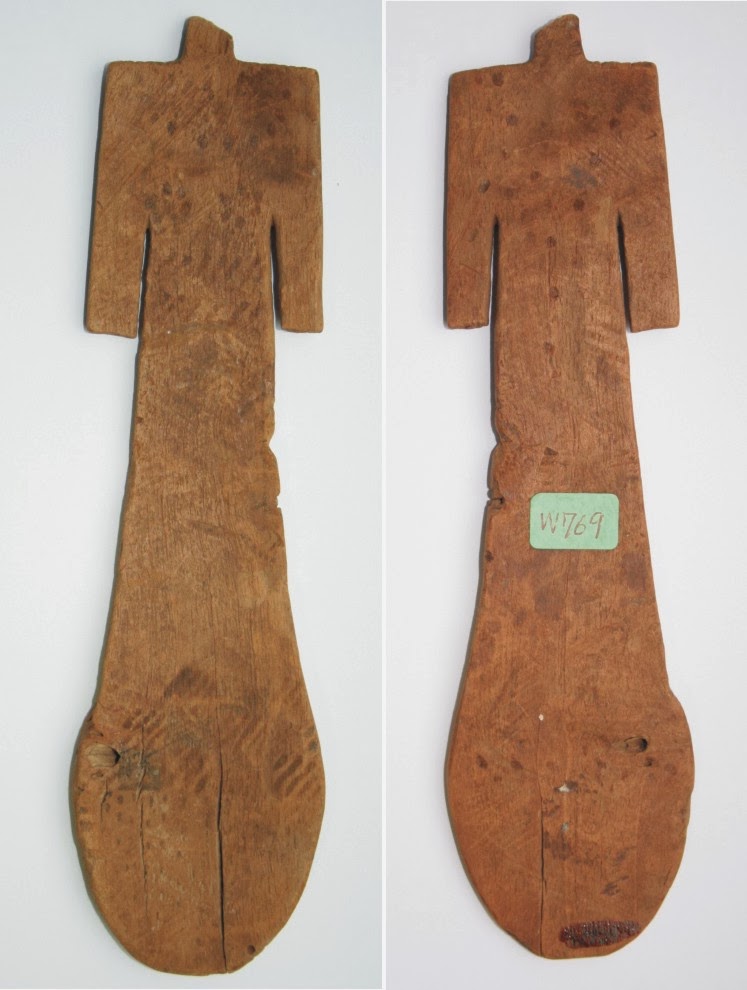
To the left is a 'paddle doll' from the Egypt Centre perhaps showing tattoos or scarification. Such items are found in Nubia and Egypt

In 1891, two ancient Egyptian female mummies were uncovered from Middle Kingdom Deir el-Bahri; they bore tattoos of geometrically arranged dots and dashes. Their burial places were adjacent to those of a number of ladies who held the title ‘King’s Wife’ and thus, the tattooed ladies were considered to be members of the king’s harem (I have blogged about this site previously). A few years later, another two female mummies were discovered in the same region. The decorations on the bodies bore striking resemblance to faience and wooden figurines of barely clothed women of the same period (a wooden version from the Egypt Centre is shown above). From the New Kingdom on, Egyptologists noticed that semi-clothed women were frequently depicted sporting depictions of the deity Bes, and suggested that these were tattoos, the marks of dancing girls - or even prostitutes. One might suggest that tattooing in Egypt was therefore associated with prostitutes and was erotically charged. Reality is a little more complex and as is often the case, ideas of the past are strongly coloured by modern preconceptions. In our own society the wearing of tattoos has been negatively associated with immorality and low social status and this preconception seems to have influenced an understanding of ancient Egyptian tattoos. In the late 1920s, for example, the conviction of a rapist was overturned because a small butterfly tattoo was found on the female victim. The tattoo was considered to have sexual implications and thus the woman was thought to have misled the man who raped her. 

Much confusion also arises from the conflation of New Kingdom depictions of Bes on scantily clad women's legs, with Middle Kingdom marks on the bodies of elite women and ‘fertility dolls’. All the evidence suggests that the only Egyptians in Dynastic Egypt to have tattoos were women, and that these women would be elite court ladies and priestesses of Hathor, perhaps decorated to ensure fertility, but not for the simple amusement of men. The origins and precise meaning of the tattoos however remain unclear.  

Much of the textual evidence for tattooing in Egypt comes from the Graeco-Roman Period, when it is clear that tattooing and branding were considered negative. Slaves were branded and tattooing was used as a punishment. Cultic tattooing, however, is also mentioned. Sextus Empiricius says that the majority of Egyptians were tattooed, and evidence suggests that both men and women were indeed tattooed in this period. However, the extent to which this took place was probably exaggerated by Classical writers to support their ideas of the ‘weird’ nature of the Egyptians. Evidence from bodies themselves suggests a less ubiquitous practice. Maspero’s excavations at Akhmim in Middle Egypt ‘yielded several female mummies of the Graeco-Roman period with tattoo marks on the chin and sides of the nose.’ While the discolouration and partial decomposition of mummified bodies means that we would not expect evidence of tattooing on every mummy, one might expect a little more available evidence than merely the Akhmim bodies. 

Prior to the Graeco-Roman Period, evidence for tattooing is largely archaeological. One of the few possible textual references comes from the Bremner-Rhind Papyrus (British Museum EA 10188). This papyrus is dated to the Fourth Century BC, but the archaizing language suggests an earlier prototype. The relevant phrase can be translated as ‘their name is inscribed into their arms as Isis and Nephthys . . . ’ The problem is that this may represent scarification rather than tattooing, and like all textual evidence, may suggest an idea rather than a reality. 

Firm evidence for tattooing must ideally come from the bodies themselves. As with the Graeco-Roman Period, the evidence does not suggest ubiquitous practice. In fact, only four mummified bodies are known, and these all from the Middle Kingdom, all from Deir el-Bahri, and all female. 

Perhaps the most well known tattooed lady is that of the Eleventh Dynasty (c. 2055–2004 BC) Priestess of Hathor, Amunet, discovered in 1891 in a tomb at Deir el-Bahri. Unfortunately, there appear to be no pictures of Amunet’s tattoos. The body often shown as Amunet in publications is actually that of her companion, an unknown lady from the same tomb who was also tattooed. Amunet had tattoos on top of the abdomen, above thighs and breasts and on lower legs and arms in a geometrical pattern of dots and lines. Her titles ‘Sole Lady in Waiting, Priestess of Hathor’ showed that she was a high status lady of the court. Although, the title Xkr.t nsw wat.t had been translated in the past as ‘Sole Royal Ornament’, and connected with concubines, a better translation may be ‘Sole Lady in Waiting’. Ladies holding the title ‘Sole Lady in Waiting, Priestess of Hathor’ were often wives of important officials. The much published tattoos of Amunet’s companion were very similar to her own. 

Amunet and her companion were buried close to the temple of King Mentuhotep Nebhepetre, in an area which seems to have been given over to other royal ladies, several of whom were priestesses of Hathor, and which are sometimes considered a harem. Even if these women were royal wives, we should not equate this with prostitution or low status. Indeed, there is even doubt that these ladies were married to the king.  

Two other female mummies, again from the Eleventh Dynasty and from Deir el-Bahri, were found by Herbert E.Winlock in 1923 near the Mentuhotep temple. These bodies appear to exhibit scarification, as well as tattooing, and the pattern of designs is like that of Amunet with geometrically arranged dots and dashes. Winlock identified them as ‘dancing girls’, apparently as their tattoos were the same as the patterns on the faience figurines which he believed to be dancing girls. However, the titles of these women, if they had any, remain unknown and they were buried with few objects, though it is possible that they had been moved from a former grave. Winlock states that their graves had been robbed during the building of Hatshepsut’s Temple. Thus, their status is unclear.  

It has been argued that elite women were not tattooed but the case of Amunet and her companion, and perhaps also of the two other Deir el-Bahri women, would suggest otherwise. Amunet’s title shows she was a court lady and she was buried near the king wearing bead collars and necklaces. Her companion in the same tomb, given its situation, appears also to be of high rank. As for the other two, the fact that they were buried on such an important site suggests that they may have been court ladies, and like many women buried here could have been priestesses of Hathor. Such women may have danced, though they are not shown doing so, and have no titles suggesting that they did so. They may or may not have been sexually intimate with the king, but they were certainly of high status. 

It has been suggested on the basis of the actual skulls, and from iconographic depictions, that some of these women were black Nubians. While representation of skin colouring as black is now known to have religious overtones, associated with Osiris, and with fertility and rebirth, rather than depicting skin colour in life, the evidence from the shape of the skull is harder to dismiss. However, the skull identification was carried out some time ago and so was possibly not as accurate as might be expected today. One scholar identifies Amunet and the two tattooed ladies found later, as light-skinned, but another, suggests that the mummification process may have reduced the melanin in the skin. Interestingly, an archaeological study has shown that some of these women had extremely narrow pelvises, a trait associated with at least some ancient Egyptian women. A new examination by a modern physical anthropologist may help resolve the matter. 

As well as these four tattooed bodies, a number of Middle Kingdom figurines have been found which not only have similar decorations, and possible Nubian origins, but are also sometimes considered concubines. These figurines fall into two main groups: faience fertility figurines classified by the British Egyptologist Geraldine Pinch as type 1, and wooden ‘paddle dolls’. Both are Middle Kingdom. There are, of course, other types of fertility figurines, but it is these two types which most approximate the Middle Kingdom mummified bodies.  

Pinch’s type 1 fertility figurines, faience ‘dolls’ decorated with geometric patterns strikingly similar to those on the mummified tattooed ladies, are discussed first. These figures date to the late Middle Kingdom–Second Intermediate Period and many are made of faience, stone, wood or ivory. Most are found in tombs, though one was found in a domestic context at Kahun. They are found in both male and female burials, as well as in votive deposits to Hathor, with the bands around their bodies being similar to the ‘Libyan bands’ worn by priestesses. While Pinch, the authority on these artefacts, is doubtful of accepting the idea of their Nubian origins, the connection does seem difficult to refute. While not identical, examples of Nubian pottery of the same date do exhibit similar patterns, and like the Egyptian figures, are without feet. The similarity of design does suggest a cross-fertilization of ideas surrounding them, particularly as Nubia was at least partly under the control of Egypt at this time.  

The decoration on the mummies, and also on the type 1 fertility figurines, bears some similarity to the decoration on paddle dolls, common in the Middle Kingdom. Such dolls, with emphasized pubic area and long hair, appear to symbolize the feminine erotic, and are usually considered fertility figures rather than children’s playthings. Interestingly, at least one of these paddle dolls sports a depiction of Taweret who, like Bes, is associated with women and childbirth. The two seem closely linked and Keimer illustrates an example of Taweret with a Bes face. We have seen that, in the New Kingdom, Bes was depicted on the thighs of some women. These paddle dolls are common in Upper Egypt and Nubia. 

The geographical distribution of paddle dolls, the possible Nubian origins of the faience and pottery figurines, and the possible Nubian origins of the Mentuhotep Nebhepetre have all been linked to evidence of a Nubian connection for tattooing. In each individual case, the evidence is not clear, with the paddle dolls being the most convincingly Nubian. It is probably going too far to claim that these dolls are somehow depictions of the tattooed ladies; the paddle dolls wear long hair, while our ladies are shown on their chapels with short hairstyles. However, perhaps together, the paddle dolls, faience dolls and Deir el-Bahri women, provide some support for a relationship between female body decoration and Nubian influence, at least in the Middle Kingdom. 

In support of Nubian origins for our ladies, Nubian women were decorated with similar tattoos between the Sixth and Eighteenth Dynasties, that is, they were contemporary with the Deir el-Bahri ladies. C-group women (2000–1500 BC), in cemeteries near Kubban discovered in 1910, also had tattoos, like those of Amunet and the other three women. Moreover, the Nubian women were buried with pottery dolls exhibiting the same tattoos. Other C-Group tattooed women have also been found exhibiting similar dot and dash patterning. One expert states that all the tattoos found in Nubia are on females, but there is at least one instance of a tattooed male from the later period in Nubia. A Nubian connection may be accepted with caution. 

An alternative suggestion is that the origins of Dynastic Egyptian tattooing may be sought in Egyptian prehistory. There are several depictions of female Predynastic figurines patterned as though tattooed. However, we do not know if this practice continued unbroken into Dynastic Egypt, or again if these patterns represent tattoos, body paint or scarification. 

We may ask how the tattoos were executed. An early Dynastic flint flake set in a wooden handle, found at Abydos, was said by Petrie to be a tattooing instrument. Petrie writes “The flint set in wood did not seem capable of bearing any strain, but it was explained by my friend Prof Giglioli as a tatuing [sic] instrument of usual form . . .”. This suggests that Professor Giglioli had seen similar contemporary items. Another instrument, consisting of wide, flat needles found together, was uncovered from Eighteenth Dynasty Gurob. The latter is now deposited in the Petrie Museum. 

Interestingly, tattooing seems to have either continued, or been revived, in more recent times in Egypt. At least one drawing of an Egyptian woman is known, as well as bone figurines, a luster ware dish and other artefacts of the Fatamid Period (AD 969–1171), apparently showing tattoos. Of course these could also indicate body paint.  

Ethnographic evidence shows that, at times, tattooing may be associated with the elite, and at other times, subordinate groups. It is frequently practised as a means of healing and protection, and thus is not always intended as mere sexual ornament. For ancient Egypt, it is certainly evident that tattooing in the Middle Kingdom was associated with some high-status women. As to the meaning of the tattoos, all that can be said is that there is some suggestion that the body decorations are associated with fertility. The faience dolls and paddle dolls are very clearly fertility figures and these have designs which appear similar to the tattooed mummies. As for the later Bes body decorations, Bes, if not an erotic symbol, was associated with women in childbirth, and hence fertility and/or protection. This, of course, need not rule out a connection with eroticism, as the fertility and eroticism are difficult to untangle. What can be ruled out is the association of tattoos and low-status women. Additionally, the paucity of tattoos suggests it was not common practice. 

The positioning of the tattoos on the abdomen and upper breasts and thighs of these mummified bodies, and also on the dolls, has suggested to some an erotic connection. However, some of the tattooing also occurred on the lower legs and arms; and besides, position near female genital areas may be associated with either fertility or protection. It is also possible that the tattoos may be marks of devotees to Hathor, given that these dolls are often given as votive offerings to Hathor, and that Amunet, and possibly the other mummified ladies, were Priestesses of Hathor.  

By the New Kingdom, women are sometimes shown with depictions of Bes upon their thighs, often assumed to be tattoos. These appear in a different tradition to the geometrical designs of the Middle Kingdom, though the difference may be superficial. The Bes ‘tattoos’ are sometimes cited as supporting the link between tattoos and eroticism in ancient Egypt and both associated with low status. However, this link is open to question for four main reasons. Firstly, we do not know if these were tattoos, scarification, or make-up. The suggestion that these may have been tattoos is supported by the interpretation of a dotted design on a Nubian Meroitic female mummy from Aksha as a Bes figure. However, the Meroitic Period is equivalent to the Ptolemaic Period of Egypt, that is, it is much later than the Egyptian New Kingdom. Secondly, Bes was associated with women and childbirth, and had an apotropaic role, thus to assume a mere erotic role limits, or even twists, the nature of Bes. Thirdly, it is possible that all Egyptian women had depictions of Bes painted upon their thighs, though they are not shown on higher status women because such women were usually depicted clothed. Fourthly, in the New Kingdom, nakedness was not simply equated with social status. Indeed, in the Amarna Period, even the royal family were shown semi-naked. The women with the depictions of Bes were very possibly high status women. It has even been suggested that one was a priestess of Hathor. There is no reason to think of these women as prostitutes. Indeed, the earliest evidence we have for prostitution in ancient egypt is for men prostituting themselves!

Finally, we need to consider the link between Bes and the erotic. Certainly Bes is sometimes shown on the thighs of women holding musical instruments, wearing hip girdles and sporting long flowing locks. The presence of a small monkey appears to enhance the erotic feel. The problem is to disentangle the erotic from the fertility aspects, which is probably largely impossible for an ancient society. It is very likely that such a distinction simply was not made in ancient Egypt.
 
(Much of this is taken from 'Dancing for Hathor': Women in Ancient Egypt but the book has the references in it)

Wednesday, 2 October 2013

More Nubian Stuff - Faience Head, a Talisman for Children


EC537 is a faience head of a Nubian. The head can be recognised as Nubian by the treatment of the eyes and by the cruciform hairstyle. The piece is 3.5cm high. It appears to belong to a larger piece. Parallels suggest a date of the Third Intermdiate Period to Late Period. 

The hairstyle appears to be associated with Nubian women (Bulté 1991, 94), who are often shown on items associated with toilet and with childbirth and motherhood (e.g Ashmolean AN1896-1908 E.1807 and the British Museum ostraca below). 

Similar examples include ECM822 in the Eton College collection (Graves 2013). Several important goddesses such as Tefnut and Sekhmet were associated with Nubia in the Late Period. Friedman (1998, 208) believes that such figures are associated with motherhood and perhaps used to protect young children. A complete example is in the Museum of Fine Arts, Boston (1951.13, in Friedman 1998 ed. 69: 109, 208 and http://www.mfa.org/search/collections?keyword=1984.168) shows a nursing figure. Graves (2013) further associates them with Beset.


A female figure with a similar hairstyle can be seen on this 19th Dynasty ostracon from Deir el-Medina (British Museum EA 8506, copyright British Museum Trustees).


References
Bulté, J. 1991. Talismans Égytiens d’Heureuse Maternité. Faïence bleu vert à pois foncés. Paris.
Friedman, F.D. ed. 1989. Gifts of the Nile: Ancient Egyptian Faience. Thames and Hudson: London.
Graves, C. 2013. Eton College Myers Collection of Egyptian Antiquities Object Highlight: ECM822, A Faience Nubian Head. Birmingham Egyptology Journal, 1. http://birminghamegyptology.co.uk/wp-content/uploads/2013/01/Eton-College-Myers-Collection-of-Egyptian-Antiquities-Object-Highlight-ECM822-A-Faience-Nubian-Head1.pdf (accessed 1.10.2013).

Other Nubian and Nubian related items in the Egypt Centre