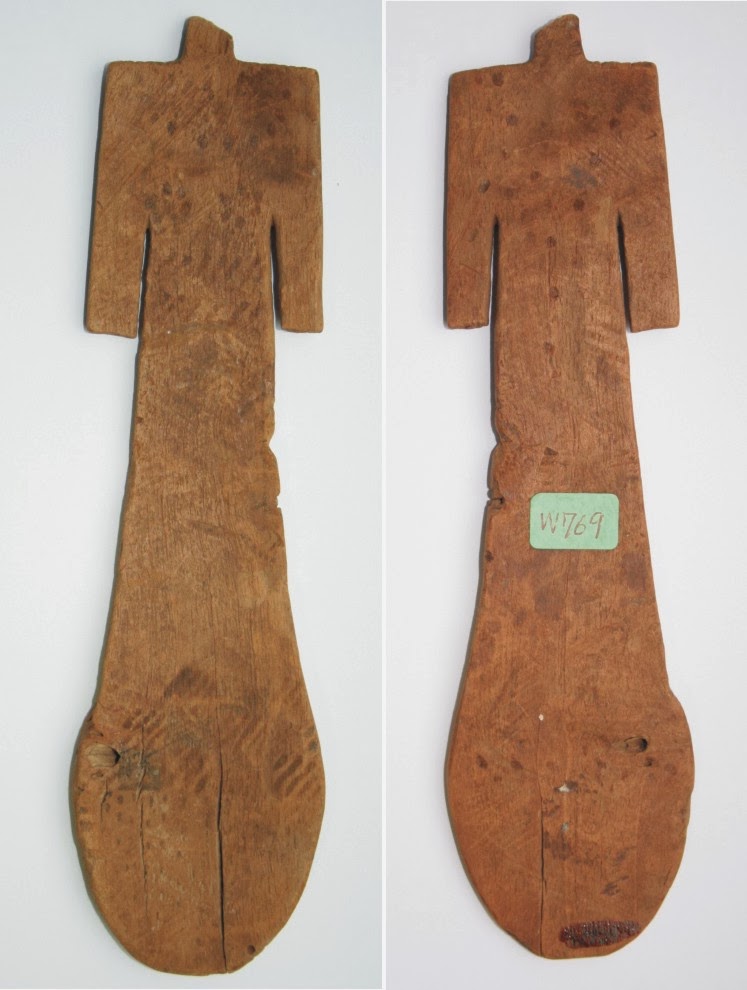
The title reflects a few myths about tattoos in ancient Egypt, and a few debatable points.
There are lots of myths about tattoos in ancient Egypt e.g. prostitutes wore tattoos of Bes, low status women only were tattooed, Amunet was a 'dancing girl'.
There are also some interesting, possible Nubian connections. Here I look at the myths and possible Nubian link.
To the left is a 'paddle doll' from the Egypt Centre perhaps showing tattoos or scarification. Such items are found in Nubia and Egypt
In 1891, two ancient Egyptian female mummies were uncovered from Middle
Kingdom Deir el-Bahri; they bore tattoos of geometrically arranged dots and
dashes. Their burial places were adjacent to those of a number of ladies who
held the title ‘King’s Wife’ and thus, the tattooed ladies were considered to
be members of the king’s harem (I have blogged about this site previously). A few years later, another two female mummies
were discovered in the same region. The decorations on the bodies bore striking
resemblance to faience and wooden figurines of barely clothed women of the same
period (a wooden version from the Egypt Centre is shown above). From the New Kingdom on, Egyptologists
noticed that semi-clothed women were frequently depicted sporting depictions of
the deity Bes, and suggested that these were tattoos, the marks of dancing girls
- or even prostitutes.
One might suggest that tattooing in Egypt was therefore associated with
prostitutes and was erotically charged. Reality is a little more complex and as
is often the case, ideas of the past are strongly coloured by modern preconceptions.
In our own society the wearing of tattoos has been negatively associated
with immorality and low social status and this preconception seems to have
influenced an understanding of ancient Egyptian tattoos. In the late 1920s, for
example, the conviction of a rapist was overturned because a small butterfly
tattoo was found on the female victim. The tattoo was considered to have sexual
implications and thus the woman was thought to have misled the man who raped
her.
Much confusion also arises from the
conflation of New Kingdom depictions of Bes on
scantily clad women's legs, with Middle Kingdom marks on the bodies of elite women and
‘fertility dolls’. All the evidence suggests that the only Egyptians in
Dynastic Egypt to have tattoos were women, and that these women would be elite
court ladies and priestesses of Hathor, perhaps decorated to ensure fertility,
but not for the simple amusement of men. The origins and precise meaning of the
tattoos however remain unclear.
Much of the textual evidence for
tattooing in Egypt
comes from the Graeco-Roman Period, when it is clear that tattooing and
branding were considered negative.
Slaves were branded and tattooing was used as a punishment. Cultic tattooing,
however, is also mentioned. Sextus Empiricius says that the majority of
Egyptians were tattooed,
and evidence suggests that both men and women were indeed tattooed in this
period. However, the extent to which this took place was probably exaggerated
by Classical writers to support their ideas of the ‘weird’ nature of the
Egyptians. Evidence from bodies themselves suggests a less ubiquitous practice.
Maspero’s excavations at Akhmim in Middle Egypt ‘yielded several female mummies
of the Graeco-Roman period with tattoo marks on the chin and sides of the
nose.’ While the discolouration and partial decomposition
of mummified bodies means that we would not expect evidence of tattooing on
every mummy, one might expect a little more available evidence than merely the
Akhmim bodies.
Prior to the
Graeco-Roman Period, evidence for tattooing is largely archaeological. One of
the few possible textual references comes from the Bremner-Rhind Papyrus
(British Museum EA 10188). This papyrus is dated to the Fourth Century BC, but
the archaizing language suggests an earlier prototype. The relevant phrase can
be translated as ‘their name is inscribed into their arms as Isis and Nephthys
. . . ’ The problem is that this may represent scarification rather than
tattooing, and like all textual evidence, may suggest an idea rather than a
reality.
Firm evidence for tattooing must
ideally come from the bodies themselves. As with the Graeco-Roman Period, the
evidence does not suggest ubiquitous practice. In fact, only four mummified
bodies are known, and these all from the Middle Kingdom, all from Deir
el-Bahri, and all female.
Perhaps the most well known tattooed
lady is that of the Eleventh Dynasty (c. 2055–2004 BC) Priestess of Hathor,
Amunet,
discovered in 1891 in a tomb at Deir el-Bahri. Unfortunately, there appear to
be no pictures of Amunet’s tattoos.
The body often shown as Amunet in publications is actually that of her
companion, an unknown lady from the same tomb who was also tattooed. Amunet had
tattoos on top of the abdomen, above thighs and breasts and on lower legs and
arms in a geometrical pattern of dots and lines. Her titles ‘Sole Lady in
Waiting, Priestess of Hathor’ showed that she was a high status lady of the
court. Although, the title Xkr.t nsw wat.t had been translated in the past as ‘Sole Royal Ornament’, and connected with
concubines, a better translation may be ‘Sole Lady in Waiting’.
Ladies holding the title ‘Sole Lady in Waiting, Priestess of Hathor’ were often
wives of important officials. The much published tattoos of Amunet’s companion
were very similar to her own.
Amunet and her companion
were buried close to the temple
of King Mentuhotep Nebhepetre, in an area which
seems to have been given over to other royal ladies, several of whom were
priestesses of Hathor, and which are sometimes considered a harem. Even
if these women were royal wives, we should not equate this with prostitution or
low status. Indeed, there is even doubt that these ladies were married to the
king.
Two other female mummies, again from
the Eleventh Dynasty and from Deir el-Bahri, were found by Herbert E.Winlock in
1923 near the Mentuhotep temple. These bodies
appear to exhibit scarification, as well as tattooing, and the pattern of
designs is like that of Amunet with geometrically arranged dots and dashes. Winlock identified them as ‘dancing
girls’, apparently as their tattoos were the same as the patterns on the
faience figurines which he believed to be dancing girls. However, the titles of
these women, if they had any, remain unknown and they were buried with few
objects, though it is possible that they had been moved from a former grave.
Winlock states that their graves had been robbed during the building of
Hatshepsut’s Temple.
Thus, their status is unclear.
It has been argued that elite women
were not tattooed
but the case of Amunet and her companion, and perhaps also of the two other
Deir el-Bahri women, would suggest otherwise. Amunet’s title shows she was a
court lady and she was buried near the king wearing
bead collars and necklaces. Her companion in the same tomb, given its situation,
appears also to be of high rank. As for the other two, the fact that
they were buried on such an important site suggests that they may have been
court ladies, and like many women buried here could have been priestesses of
Hathor. Such women may have danced, though they are not shown doing so, and
have no titles suggesting that they did so. They may or may not have been
sexually intimate with the king, but they were certainly of high status.
It has been suggested on the basis
of the actual skulls, and from iconographic depictions, that some of these
women were black Nubians. While representation of skin colouring as black is
now known to have religious overtones, associated with Osiris, and with
fertility and rebirth, rather than depicting skin colour in life, the evidence
from the shape of the skull is harder to dismiss. However, the skull
identification was carried out some time ago and so was possibly not as
accurate as might be expected today. One scholar
identifies Amunet and the two tattooed ladies found later, as light-skinned,
but another,
suggests that the mummification process may have reduced the melanin in the
skin. Interestingly, an archaeological study has shown
that some of these women had extremely narrow pelvises, a trait associated with
at least some ancient Egyptian women. A new examination by a modern physical
anthropologist may help resolve the matter.
As well as these four tattooed
bodies, a number of Middle Kingdom figurines have been found which not only
have similar decorations, and possible Nubian origins, but are also sometimes
considered concubines. These figurines fall into two main groups: faience
fertility figurines classified by the British Egyptologist Geraldine Pinch as
type 1, and wooden ‘paddle dolls’. Both are Middle Kingdom. There are, of
course, other types of fertility figurines, but it is these two types which most
approximate the Middle Kingdom mummified bodies.
Pinch’s type 1 fertility figurines,
faience ‘dolls’ decorated with geometric patterns strikingly similar to those
on the mummified tattooed ladies, are discussed first. These figures date to
the late Middle Kingdom–Second Intermediate Period and many are made of
faience, stone, wood or ivory. Most are found in tombs, though one was found in
a domestic context at Kahun.
They are found in both male and female burials, as well as in votive deposits
to Hathor, with the bands around their bodies being similar to the ‘Libyan
bands’ worn by priestesses. While Pinch,
the authority on these artefacts, is doubtful of accepting the idea of their
Nubian origins, the connection does seem difficult to refute. While not
identical, examples of Nubian pottery of the same date do exhibit similar
patterns, and like the Egyptian figures, are without feet. The similarity of
design does suggest a cross-fertilization of ideas surrounding them,
particularly as Nubia was at
least partly under the control of Egypt at this time.
The decoration on the mummies, and
also on the type 1 fertility figurines, bears some similarity to the decoration
on paddle dolls, common in the Middle Kingdom.
Such dolls, with emphasized pubic area and long hair, appear to symbolize the
feminine erotic, and are usually considered fertility figures rather than
children’s playthings. Interestingly, at least one of these paddle dolls sports
a depiction of Taweret
who, like Bes, is associated with women and childbirth. The two seem closely
linked and Keimer
illustrates an example of Taweret with a Bes face. We have seen that, in the New Kingdom, Bes was depicted on the thighs of some
women. These paddle dolls are common in Upper Egypt and Nubia.
The geographical distribution of
paddle dolls, the possible Nubian origins of the faience and pottery figurines,
and the possible Nubian origins of the Mentuhotep Nebhepetre have all been linked to evidence of
a Nubian connection for tattooing. In each individual case, the evidence is not
clear, with the paddle dolls being the most convincingly Nubian. It is probably
going too far to claim that these dolls are somehow depictions of the tattooed
ladies; the paddle dolls wear long hair, while our ladies are shown on their
chapels with short hairstyles. However, perhaps together, the paddle dolls,
faience dolls and Deir el-Bahri women, provide some support for a relationship
between female body decoration and Nubian influence, at least in the Middle
Kingdom.
In support of Nubian origins for our
ladies, Nubian women were decorated with similar tattoos between the Sixth and
Eighteenth Dynasties,
that is, they were contemporary with the Deir el-Bahri ladies. C-group women
(2000–1500 BC), in cemeteries near Kubban discovered in 1910, also had tattoos,
like those of Amunet and the other three women. Moreover, the Nubian women were
buried with pottery dolls exhibiting the same tattoos.
Other C-Group tattooed women have also been found
exhibiting similar dot and dash patterning. One expert
states that all the tattoos found in Nubia
are on females, but there is at least one instance of a tattooed male from the
later period in Nubia.
A Nubian connection may be accepted with caution.
An alternative suggestion is that
the origins of Dynastic Egyptian tattooing may be sought in Egyptian
prehistory. There are several depictions of female Predynastic figurines
patterned as though tattooed.
However, we do not know if this practice continued unbroken into Dynastic
Egypt, or again if these patterns represent tattoos, body paint or
scarification.
We may ask how the
tattoos were executed. An
early Dynastic flint flake set in a wooden handle, found at Abydos, was said by Petrie to be a tattooing
instrument. Petrie writes “The flint set in wood did not seem capable of
bearing any strain, but it was explained by my friend Prof Giglioli as a
tatuing [sic] instrument of usual form . . .”.
This suggests that Professor Giglioli had seen similar contemporary items. Another instrument, consisting of
wide, flat needles found together, was uncovered from Eighteenth Dynasty Gurob.
The latter is now deposited in the Petrie
Museum.
Interestingly, tattooing seems to
have either continued, or been revived, in more recent times in Egypt.
At least one drawing of an Egyptian woman is known, as well as bone figurines,
a luster ware dish and other artefacts of the Fatamid Period (AD 969–1171),
apparently showing tattoos.
Of course these could also indicate body paint.
Ethnographic evidence shows that, at
times, tattooing may be associated with the elite, and at other times,
subordinate groups.
It is frequently practised as a means of healing and protection, and thus is
not always intended as mere sexual ornament. For ancient Egypt, it is certainly evident that
tattooing in the Middle Kingdom was associated with some high-status women. As
to the meaning of the tattoos, all that can be said is that there is some
suggestion that the body decorations are associated with fertility. The faience
dolls and paddle dolls are very clearly fertility figures and these have
designs which appear similar to the tattooed mummies. As for the later Bes body
decorations, Bes, if not an erotic symbol, was associated with women in
childbirth, and hence fertility and/or protection. This, of course, need not
rule out a connection with eroticism, as the fertility and eroticism are
difficult to untangle. What can be ruled out is the association of tattoos and
low-status women. Additionally, the paucity of tattoos suggests it was not
common practice.
The positioning of the tattoos on
the abdomen and upper breasts and thighs of these mummified bodies, and also on
the dolls, has suggested to some an erotic connection. However, some of the
tattooing also occurred on the lower legs and arms;
and besides, position near female genital areas may be associated with either
fertility or protection. It is also possible that the tattoos may be marks of
devotees to Hathor, given that these dolls are often given as votive offerings
to Hathor, and that Amunet, and possibly the other mummified ladies, were
Priestesses of Hathor.
By the New
Kingdom, women are sometimes shown with depictions of Bes upon
their thighs, often assumed to be tattoos. These appear in a different
tradition to the geometrical designs of the Middle Kingdom, though the
difference may be superficial. The Bes ‘tattoos’ are sometimes cited as
supporting the link between tattoos and eroticism in ancient Egypt and both associated with low status. However, this link is open
to question for four main reasons. Firstly, we do not know if these were
tattoos, scarification, or make-up. The suggestion that these may have been
tattoos is supported by the interpretation of a dotted design on a Nubian
Meroitic female mummy from Aksha as a Bes figure.
However, the Meroitic Period is equivalent to the Ptolemaic Period of Egypt,
that is, it is much later than the Egyptian New Kingdom. Secondly, Bes was
associated with women and childbirth, and had an apotropaic role, thus to
assume a mere erotic role limits, or even twists, the nature of Bes. Thirdly,
it is possible that all Egyptian women had depictions of Bes painted upon their
thighs, though they are not shown on higher status women because such women
were usually depicted clothed. Fourthly, in the New Kingdom, nakedness was not simply equated with social status. Indeed, in the Amarna Period, even the royal family were shown semi-naked. The women with the depictions of Bes were very possibly high status women. It has even been suggested that one was a priestess of Hathor. There is no reason to think of these women as prostitutes. Indeed, the earliest evidence we have for prostitution in ancient egypt is for men prostituting themselves!
Finally, we need to consider the link between
Bes and the erotic. Certainly Bes is sometimes shown on the thighs of women
holding musical instruments, wearing hip girdles and sporting long flowing locks.
The presence of a small monkey
appears to enhance the erotic feel. The problem is to disentangle the erotic
from the fertility aspects, which is probably largely impossible for an ancient
society. It is very likely that such a distinction simply was not made in
ancient Egypt.
.JPG) Addendum: since this article was written a slightly older foetus has been found at the Fitzwilliam, Cambridge, What both show is that we should not rely on X-rays but rather CT scans for such tiny mummies. I wonder how many more are extant in museums.
Addendum: since this article was written a slightly older foetus has been found at the Fitzwilliam, Cambridge, What both show is that we should not rely on X-rays but rather CT scans for such tiny mummies. I wonder how many more are extant in museums. But the question remains, is there a child in this mummy
case? In 1998 Singleton hospital kindly agreed to X-ray the cartonnage case but
the results were inconclusive. Then on 28th April Swansea
Univerity’s Paola
Griffiths of Clinical Imaging College of Medicine kindly CT scanned the artefacts. This
showed most of the interior was taken by folded of a material, presumably linen
bandages and within that an area is a darker area about 10cm long which appears
to be a foetus (in foetal position and with placental sac) and what could be a
femur. The length of the femur together with the size of the dark patch is
consistent with that of a 12-16 week old foetus. Another dark patch suggests
and amulet and there are several areas with dark circles resembling strings of
beads or tassels. It is not unusual for strings of beads to be placed loose in
mummy wrappings of this date. For example, the British Museum mummy EA6676.
But the question remains, is there a child in this mummy
case? In 1998 Singleton hospital kindly agreed to X-ray the cartonnage case but
the results were inconclusive. Then on 28th April Swansea
Univerity’s Paola
Griffiths of Clinical Imaging College of Medicine kindly CT scanned the artefacts. This
showed most of the interior was taken by folded of a material, presumably linen
bandages and within that an area is a darker area about 10cm long which appears
to be a foetus (in foetal position and with placental sac) and what could be a
femur. The length of the femur together with the size of the dark patch is
consistent with that of a 12-16 week old foetus. Another dark patch suggests
and amulet and there are several areas with dark circles resembling strings of
beads or tassels. It is not unusual for strings of beads to be placed loose in
mummy wrappings of this date. For example, the British Museum mummy EA6676.